
Expel the Sunni and Shia: Settler project for Greater Israel sets its sights on Syria
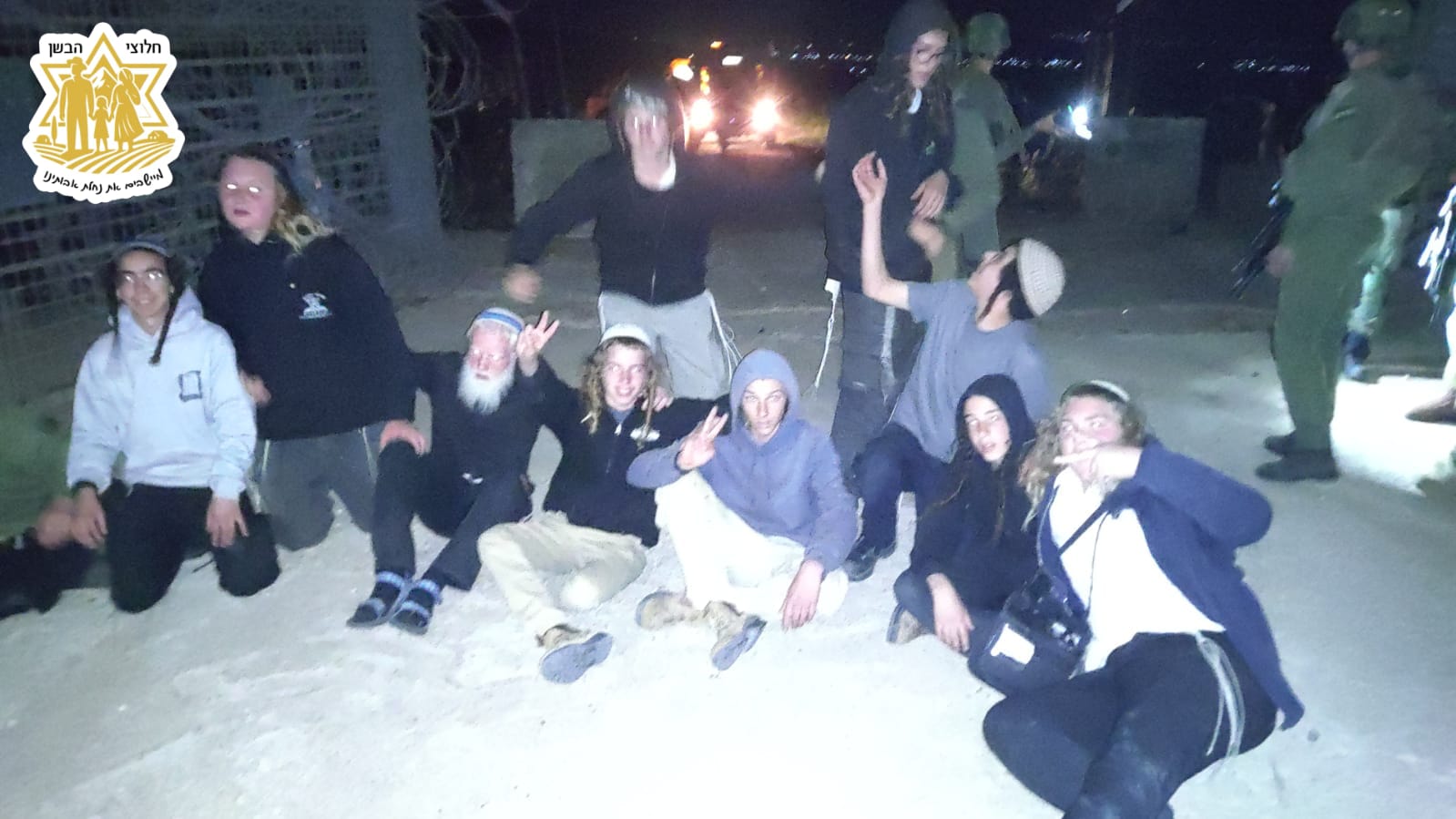
A group of Israeli settler activists gathered along the fence separating the occupied Golan Heights from southern Syria in mid-May.
Some chained themselves to the barrier while at least ten crossed into Syrian territory near the town of Majdal Shams, at the foot of Mount Hermon (Jabal al-Sheikh).
Organised by Halutzei HaBashan (Pioneers of Bashan), the act was the latest in a series of provocations demanding that Israel authorise Jewish settlements beyond the 1974 ceasefire line.
Israel's military later confirmed that "[soldiers] returned the civilians to Israeli territory and apprehended them," transferring them to the Israeli police.
Since its founding, Halutzei HaBashan has emerged as one of the most prominent movements advocating for permanent settlement in Syria beyond the 1974 ceasefire line.
New MEE newsletter: Jerusalem Dispatch
Sign up to get the latest insights and analysis on Israel-Palestine, alongside Turkey Unpacked and other MEE newsletters
The Golan Heights have been occupied since 1967 and Israel's annexation of the Syrian territory has been recognised by Washington.
Over the past year, the movement has evolved from a fringe group into a larger and more coordinated movement with ministers and members of the Israeli parliament lending it public support.
Following the May incursion, the movement told the Israeli news outlet Srugim that they "will not back down and will not stop until the right-wing government allows families who wish to do so to enter and settle in Bashan in an organised and legal manner."
Who are the 'Pioneers of Bashan'?
Halutzei HaBashan was founded in April 2025, months after Israeli forces rushed to grab land inside southern Syria by capitalising on the fall of Bashar al-Assad's government in December 2024.
The movement takes its name from Bashan, the biblical region east of the Jordan River that, according to the Hebrew Bible, stretched from Mount Hermon in the north to Gilead in the south.
According to the Greater Israel project, the State of Israel has no defined borders and, according to religious Zionists, the boundaries promised to them in the Bible stretch from the Nile river in Egypt to the Euphrates in Iraq, as far north as Hatay in Turkey and as far south as the Hejaz in Saudi Arabia.
'All the sons of the Sunni and the Shia that are in the Bashan area will be expelled and destroyed until they are worthless and powerful as the dust of the earth'
- Halutzei HaBashan, Israeli settler group
The movement therefore views Syria not as foreign territory but as part of the ancestral Jewish homeland with southern Syria being the immediate objective.
According to Murad Mohammed al-Hamwi, an open-source investigative journalist, while the group's public activity is recent, its members are far from amateurs taking advantage of the chaotic situation after the Assad dynasty's demise.
"These are unarmed and veteran settlers, many coming directly from the West Bank and the occupied Golan, with a long-term objective of establishing permanent Jewish settlements in the country's south," he told Middle East Eye.
The group's public ideology often crosses into explicit calls for ethnic cleansing of its local population.
In an April Facebook post reviewed by MEE, it called for the expulsion of all Sunni and Shia from the Bashan region, declaring that the area would "flourish" only under Israeli rule.
It read: “All the sons of the Sunni and the Shia that are in the Bashan area will be expelled and destroyed until they are worthless and powerful as the dust of the earth, and the Bashan rope will flourish and achieve in the regime of the sons of Israel to their land!”
The movement's leading public figure is Amos Azaria, an Israeli academic, religious-nationalist activist and long-time advocate of Jewish settlement beyond Israel's internationally recognised borders.
In interviews and public statements, Azaria has argued that Israel's military presence in southern Syria should be followed by permanent Jewish civilian settlement, presenting Bashan as both a strategic security buffer and a biblical inheritance.
Azaria also serves as a key ideological bridge between various radical expansionist movements.
His ambitions are not limited to the Syrian border; he is also a prominent leader in Uri Tzafon, a far-right, religious Zionist movement, an officially registered Israeli organisation that campaigns for Jewish settlement in southern Lebanon.
Alongside Azaria, the group is led by Jonathan Levy, the field coordinator who provides the strategic rationale for the incursions, and spokesperson Yosef Luria, who focuses on lobbying the Israeli state to facilitate the administrative framework for these outposts.
Military gates. New bases. Land seizures.
— Middle East Eye (@MiddleEastEye) July 1, 2026
Israel has been steadily expanding its footprint beyond the occupied Golan Heights.
Drawing on data from Sijil, our investigation examines more than 1,600 alleged violations and the strategy behind Israel’s growing presence in Syria pic.twitter.com/w0JePt7TfF
After Syrian President Ahmad al-Sharaa took power, Levy argues that civilian settlement is the "only true deterrent" against the "new Syrian threat”.
The movement draws much of its support from religious-nationalist communities in the occupied Golan Heights and settlements in the occupied West Bank.
"Azaria has made it clear they will not stop at a narrow strip. They are now openly discussing expanding control deep into the Syrian south, including the province of Daraa," Hamwi added.
Halutzei HaBashan is also closely connected to other religious-nationalist settlement organisations pursuing similar projects beyond Israel's recognised borders. Azaria is a senior figure in Uri Tzafon, which campaigns for Jewish settlement in southern Lebanon.
At the same time, the movement has cultivated ties with Nachala, the organisation leading efforts to re-establish Jewish settlements in the Gaza Strip.
Together, the three movements reveal growing cooperation between settlement movements operating across multiple fronts, each advocating Jewish settlement in territory captured or occupied during recent conflicts.
Political support
For Azaria, southern Syrian is not just a site for settlements, but the centrepiece of a broader expansionist project.
In a February interview with the right-wing platform Hakol Hayehudi, Azaria described Syria as the "most ripe arena for change," explicitly rejecting the idea of a narrow buffer zone.
'The real danger begins when they move closer to populated Syrian towns, where the potential for violent friction becomes almost inevitable'
- Murad Mohammed al-Hamwi, journalist
Instead, he has called for a deeper occupation that would extend as far as Daraa, betting that persistent border incursions will eventually force the Israeli government to accept these settlements as reality.
According to Hamwi, this legitimisation reached a symbolic peak in early 2026, when the movement was officially honoured in the Israeli Knesset at an event titled "Tribute to the Pioneers of Settlement".
During the event, the Knesset officially honoured the Halutzei HaBashan movement and its founder Azaria, presenting them with what Hamwi describes as “special certificates of appreciation”.
These awards were signed by National Security Minister Itamar Ben Gvir, a figure who is known to be one of the most prominent supporters of settler activities, signalling a new level of state endorsement.
Minister of Diaspora Affairs Amichai Chikli has emerged as a key supporter, publishing a video in February in which he declared: "This is our land, and returning to Bashan is essential." He also openly expressed his approval of the movement’s actions.
Lobbying for the infrastructure of permanence, the movement has shared a photo on X of Azaria with Communications Minister Shlomo Karhi, who has been approached to facilitate the extension of Israeli cellular networks into the "Bashan" region.
בשבוע שעבר נפגשנו עם שר התקשורת @shlomo_karhi. בפגישה הצגנו את עקרונות התנועה, ושוחננו על קידום הקליטה הסלולרית בחבל הבשן ובכתר החרמון.
אנו מודים לו על הזמן שהקדיש וממשיכים לפעול למען ההתיישבות במקום.
כי הגיע הזמן לחזור לבשן!