
Exclusive: Healthcare coalition tells UK government not to enforce chilling NHS censorship on Palestine
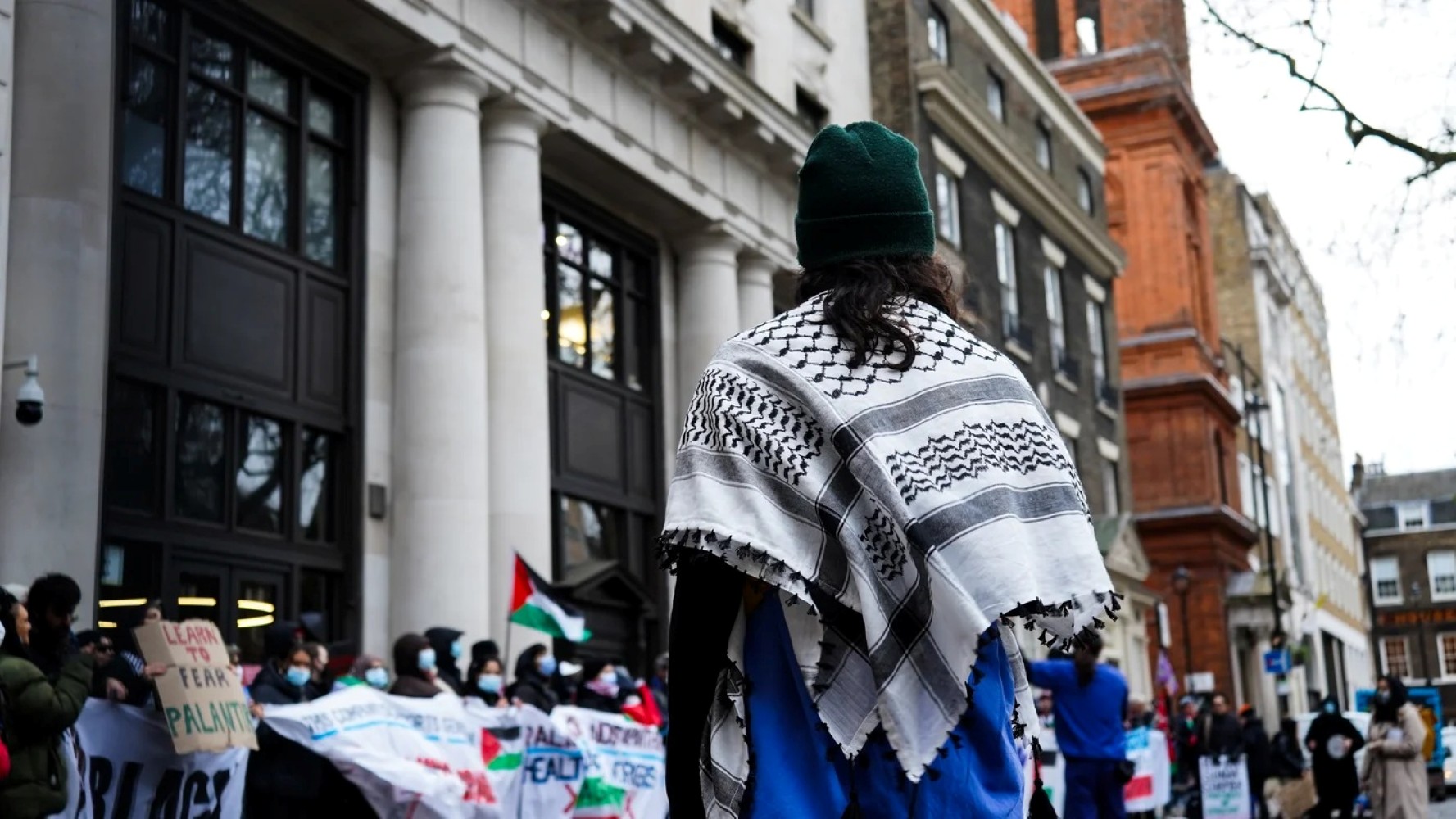
A coalition of medical associations representing over 13,000 healthcare workers in the UK is calling on the British government to immediately pause the rollout of a series of measures that would censor pro-Palestine advocacy within the National Health Service (NHS).
Last week the Department of Health and Social Care (DHSC) endorsed a review into anti-Jewish hate and other forms of racism in the NHS by the UK government’s advisor on antisemitism, Lord John Mann.
The review recommends mandatory antisemitism training for 1.5 million NHS staff members, as well as banning them from displaying political symbols in the workplace and preventing them from attending protests in their uniforms.
But the coalition, which includes a number of associations representing Muslim, Middle Eastern, and South Asian healthcare professionals, issued a response to Mann’s review on Thursday and submitted a letter to the government.
In a statement shared exclusively with Middle East Eye, the group warns that Mann’s recommendations to tackle racism “are being implemented without meaningful engagement with established evidence or affected communities”.
New MEE newsletter: Jerusalem Dispatch
Sign up to get the latest insights and analysis on Israel-Palestine, alongside Turkey Unpacked and other MEE newsletters
MEE can also reveal that some of the medical associations listed in Mann’s acknowledgements were not involved with shaping his proposals, including the British Islamic Medical Association.
Furthermore, the coalition has raised concerns about Mann’s proposed restrictions on banning political symbols, describing them as “chilling”, and “an encroachment into matters of private conscience and lawful speech that fall outside properly defined professional conduct”.
‘Hierarchy of racism’
NHS data shows that minority ethnic NHS staff consistently experience higher levels of racism compared to their white counterparts.
Roger Kline, who the healthcare regulator the General Medical Council (GMC) commissioned in 2018 to look into why a disproportionate number of ethnic minority healthcare staff are involved in fitness-to-practice processes, has exclusively told MEE he believes the review was a “missed opportunity” to tackle racism in the NHS.
'Lord Mann has been too closely aligned with defending the interests of Israel rather than that of all Jewish people'
- Roger Kline, research fellow at Middlesex University Business School
He also said that Lord Mann was the wrong person to lead it.
“The review hardly mentions Islamophobia, which is at least as important as antisemitism in the health service – this could create a hierarchy of racism,” he said.
“Antisemitism does need challenging - I'm Jewish myself - but it is certainly possible to be heavily critical of Israel without being antisemitic.
“Lord Mann has been too closely aligned with defending the interests of Israel rather than that of all Jewish people.”
Kline, who is a research Fellow at Middlesex University Business School, told MEE that he doesn’t think wearing badges showing support for Palestine or going on demonstrations is antisemitic.
“This all feels performative and may run into all sorts of legal issues.”
Kline also believes the mandatory training will be “pointless and counterproductive”, and revealed that senior NHS staff have agreed with his views but are fearful of speaking out.
‘Sustained period of harassment’
A number of doctors are currently being investigated by the GMC for pro-Palestine advocacy, including posts on social media and comments made at protests.
Dr Ranjeet Brar, a vascular surgeon in London, was suspended by King's College Hospital NHS Foundation Trust for giving a speech at a demonstration earlier this year in which he made a series of remarks criticising Israel.
Brar was arrested for his comments but released without charge, and is now being investigated by the GMC.
“I’ve been subjected to a long and sustained period of harassment because of my political views,” he told MEE.
“I’ve been labelled a racist and an antisemite for speaking out against genocide.
Mann’s review of antisemitism relies on the International Holocaust Remembrance Alliance (IHRA) definition of it, which has been the subject of much debate because it connects criticism of Israel with antisemitism.
Brar has launched a judicial review challenging the use of the IHRA definition.
“I’ve exercised my right to free speech. I’ve been cleared of wrongdoing - why should my principles and beliefs be discarded for my ability to work,” he said.
Another doctor, Tamara Ali, who is a GP in Scotland, was the subject of a complaint by a patient last year over a small Palestine flag in her consulting room and a badge on her clothing. She was instructed by colleagues to remove them both.
“It was the most isolating and anxiety-provoking period of my career. I felt completely unseen,” she told MEE.
'The complaint described the Palestine flag as a terrorist flag and compared it to Nazi symbols'
- Dr Tamara Ali, GP
“The complaint described the Palestine flag as a terrorist flag and compared it to Nazi symbols, yet none of my colleagues thought this was racist or Islamophobic," she said.
Ali has brought a legal case against her former GP practice and NHS Education for Scotland, on the grounds of racial and religious discrimination and suppression of freedom of expression.
“You can ban pins and political symbols, but you can’t ban the moral clarity people have,” Ali said.
The campaign group Healthcare Workers Against Censorship, which Ali and Brar co-founded, is seeking judicial reviews into how healthcare workers are being censored, as well as into the GMC's ability to appeal decisions of its own tribunal service.
Such a move would allow the regulator to re-investigate and sanction doctors who have been cleared of wrongdoing.
Many healthcare workers believe this is a way of cracking down on doctors who advocate for Palestine, such as in the case of British-Palestinian surgeon Dr Ghassan Abu-Sitta.
The GMC’s tribunal service cleared him of accusations of antisemitism and glorifying terrorism, but the regulator is now asking the High Court to review the decision.
‘Weaponising antisemitism’
Jonathan Fluxman, a retired anti-Zionist Jewish doctor who attends pro-Palestine solidarity events, told MEE he believes Mann’s review exaggerates and exceptionalises antisemitism.
“The only time I’ve been subjected to gross antisemitism is in public spaces such as at demonstrations; I’ve been targeted for being an anti-Zionist Jew, and the people perpetrating that are Zionist Jews,” he told MEE.
“This is an example of the British government weaponising antisemitism to clamp down on the pro-Palestine movement, because their foreign policy is to support Israel and the genocide.
“The hypocrisy and double standards are astonishing - a couple of weeks after 7th October [2023], the Department of Health flew the Israeli flag from its building and tweeted in solidarity with the people of Israel, and they also encouraged staff to show solidarity with Ukraine.
“They don’t want health workers to speak out about this because we are listened to and trusted by the public, but you can’t be neutral in genocide.”
The campaign group Health Workers 4 Palestine said Mann’s review risks “suppressing the NHS's long tradition of humanitarian advocacy by healthcare professionals” and that it would consider legal action against it.
middleeasteye.net